
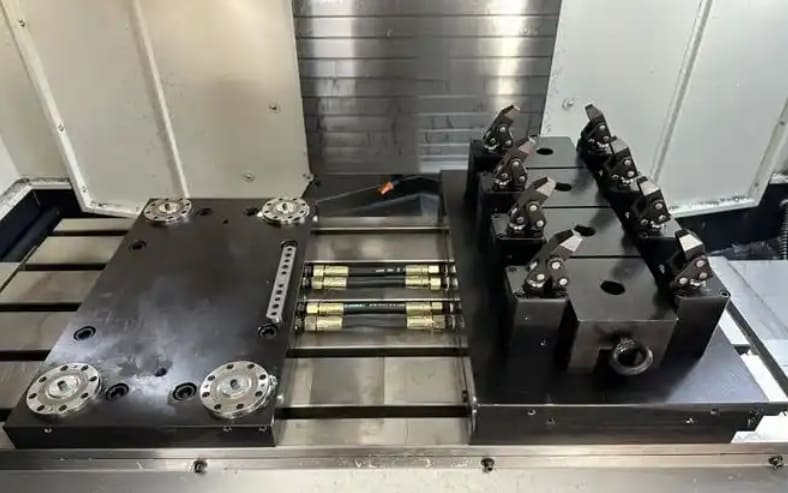
CNC high-rigidity fixturing methods have become a defining factor in achieving dimensional stability, surface integrity, and process consistency when machining thin sheet metal components across aerospace, automotive, electronics, and precision industrial sectors. Thin sheet metal presents a unique machining challenge because of its low structural stiffness, high susceptibility to vibration, thermal distortion, and elastic deformation under cutting forces. Even minimal tool pressure can induce deflection that permanently alters part geometry, leading to tolerance failures, surface waviness, burr formation, and residual stress accumulation. In response to these challenges, high-rigidity fixturing systems are no longer viewed as passive workholding devices but as active stability platforms that directly influence machining accuracy and throughput. Advanced CNC operations now rely on rigid fixturing architectures that combine mechanical reinforcement, dynamic clamping strategies, and vibration-damping materials to transform flexible sheet metal into a structurally stable machining substrate. As manufacturing industries continue pushing toward lighter components, thinner gauges, and higher production speeds, the strategic design and deployment of high-rigidity fixturing methods have emerged as one of the most critical success factors in modern CNC sheet metal machining.
The fundamental objective of high-rigidity fixturing in thin sheet metal machining is to control deformation at every stage of the cutting process, from initial clamping through final tool pass. Traditional point-contact clamping methods often create localized stress zones that cause micro-warping, particularly when working with aluminum, stainless steel, titanium, and copper alloys commonly used in precision manufacturing. Modern high-rigidity fixturing systems overcome this limitation by distributing clamping forces evenly across the sheet surface, using full-contact vacuum beds, adaptive mechanical grids, and modular sub-plate architectures that maximize support density. These systems convert the thin sheet into a quasi-rigid platform by suppressing harmonic vibration modes and minimizing unsupported spans that amplify cutting-force deflection. The effectiveness of these fixturing solutions is further enhanced by integrating force-balanced actuation that dynamically adapts to tool loads in real time. By maintaining constant contact pressure regardless of tool path direction, depth of cut, or feed rate variation, high-rigidity CNC fixturing ensures that the material remains stable throughout multi-axis machining cycles, significantly improving both positional accuracy and surface finish consistency.
Thermal control and vibration suppression represent another critical dimension of CNC high-rigidity fixturing for thin sheet metal machining, particularly under high-speed and high-feed cutting conditions. Thin sheets heat rapidly under tool engagement, and because of their low thermal mass, they are especially vulnerable to rapid expansion and contraction. If the fixturing system does not provide adequate thermal dissipation or constraint management, this expansion can cause dimensional drift and unpredictable part distortion once the part is unclamped. High-rigidity fixturing methods now incorporate thermally stable materials, closed-loop coolant flow channels within fixture bases, and vibration-absorbing composite layers that insulate the sheet from both heat and dynamic excitation. These hybrid fixtures act as both mechanical stabilizers and thermal regulators, ensuring that the part maintains geometric stability throughout prolonged machining cycles. Advanced vibration-damping polymers and constrained-layer damping structures embedded into fixture platforms further reduce tool chatter and harmonic resonance, which are among the primary contributors to tool wear acceleration and micro-tearing on thin metal surfaces. The result is not only superior dimensional precision but also extended tool life and significantly reduced scrap rates.
The increasing complexity of modern product geometry has also driven the evolution of high-rigidity fixturing toward adaptive and reconfigurable architectures capable of supporting a wide range of part profiles without sacrificing stiffness. In electronics, medical devices, and aerospace substructures, thin sheet metal components often feature intricate cutouts, micro-channels, and variable thickness zones that require unrestricted tool access while maintaining absolute stability. High-rigidity modular fixturing systems address this requirement by allowing rapid repositioning of mechanical support nodes beneath high-stress machining zones while preserving a locked structural network across the entire work envelope. These systems are frequently integrated with digital twin simulations that map tool forces and predicted deflection zones prior to machining. By aligning support density with real-time stress distribution, designers can ensure that every critical region of the sheet receives optimal backing during material removal. The result is a fixturing ecosystem that adapts dynamically to changing part geometry, cutting parameters, and material properties, providing a unified solution for both prototyping and large-scale production without sacrificing machining rigidity.
From a production economics perspective, CNC high-rigidity fixturing methods directly influence cycle time reduction, cost efficiency, and overall equipment effectiveness in thin sheet metal manufacturing. Poor fixturing leads to conservative cutting parameters, frequent quality rejections, secondary straightening operations, and excessive inspection overhead. By contrast, a properly engineered high-rigidity fixturing solution enables aggressive feed rates, deeper cuts, and uninterrupted multi-axis tool paths without compromising accuracy. This allows manufacturers to compress cycle times while maintaining micron-level tolerances across large batch volumes. Additionally, fixturing repeatability ensures that part-to-part consistency remains stable over long production runs, reducing statistical variation and simplifying quality control workflows. As CNC machining continues evolving toward lights-out manufacturing and unmanned production cells, the reliability of high-rigidity fixturing becomes even more crucial. Automated systems cannot compensate for unstable workholding, making fixturing integrity a foundational pillar of smart manufacturing scalability.
Looking ahead, the future of CNC high-rigidity fixturing for thin sheet metal machining is being reshaped by intelligent actuation systems, sensor-driven feedback loops, and AI-assisted deformation control. Next-generation fixtures are beginning to incorporate embedded strain gauges, pressure sensors, and real-time displacement monitoring that continuously analyze part behavior under load. These systems allow the fixturing platform to adjust clamping force dynamically to counteract emerging distortion patterns as machining progresses. AI-driven process control can further optimize support placement and clamping pressure based on historical machining data, material batch variation, and ambient environmental conditions. In parallel, additive manufacturing is enabling the production of topology-optimized fixture structures that deliver exceptional stiffness-to-weight ratios tailored to specific part geometries. This convergence of smart sensing, digital simulation, and ultra-rigid mechanical architecture ensures that CNC high-rigidity fixturing will remain a core enabler of precision thin sheet metal machining as industries continue pushing the limits of miniaturization, structural efficiency, and production throughput.